
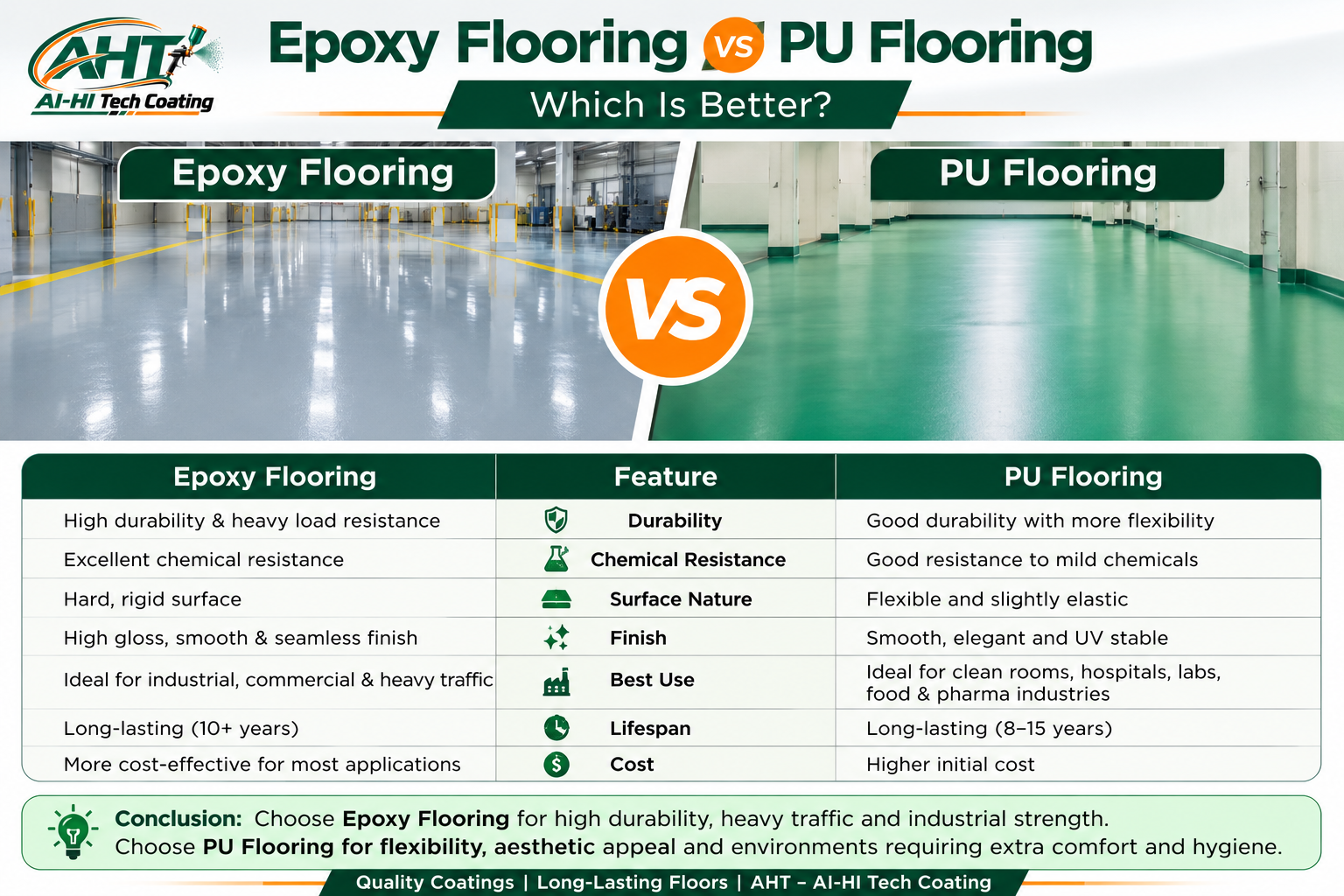
Epoxy and polyurethane (PU) flooring are two popular flooring solutions used in industrial, commercial and high-traffic environments. Both systems provide durable, seamless and easy-to-maintain surfaces, but they have different performance characteristics.
Choosing between epoxy and PU flooring depends on the environment, traffic, chemical exposure, temperature, flexibility, UV exposure and the specific requirements of the project.
Understanding epoxy and PU flooring
Epoxy flooring is a resin-based flooring system formed by combining epoxy resin with a hardener.
Once cured, it provides a hard, durable and seamless surface with good resistance to abrasion and many chemicals.
PU flooring, or polyurethane flooring, is a polymer-based system known for its flexibility, abrasion resistance and ability to perform well under temperature changes and demanding environments.
Neither system is automatically better for every application. The right choice depends on how and where the floor will be used.
Epoxy vs PU flooring: Key differences
Factor | Epoxy Flooring | PU Flooring |
Hardness | High | High, with greater flexibility |
Abrasion resistance | Excellent | Excellent |
Chemical resistance | Excellent for many applications | Excellent, depending on system |
Flexibility | Lower | Higher |
Impact resistance | Good to excellent | Excellent |
Temperature variation | Moderate to good | Better suited to thermal movement |
UV resistance | Depends on formulation/topcoat | Generally better for UV-exposed applications |
Surface finish | Wide range of finishes | Wide range of finishes |
Maintenance | Easy | Easy |
Typical applications | Factories, warehouses, workshops, commercial areas | Food plants, industrial areas, areas with temperature variation |
Best suited for | Hard-wearing, economical industrial flooring | Flexible, demanding and temperature-sensitive environments |
1. Epoxy flooring
Epoxy flooring is widely used where a hard, durable and seamless surface is required.
It can be installed in different systems and thicknesses depending on the requirements of the project.
Advantages of epoxy flooring
- High mechanical strength
- Excellent abrasion resistance
- Good resistance to many chemicals
- Seamless and easy-to-clean surface
- Available in different colours and finishes
- Suitable for heavy pedestrian and industrial traffic
- Can provide a smooth, decorative appearance
- Suitable for warehouses, factories and workshops
Epoxy flooring can also be designed as self-leveling, high-build or other specialized systems depending on the application.
Common applications
Epoxy flooring is commonly used in:
- Factories
- Warehouses
- Automobile workshops
- Manufacturing facilities
- Showrooms
- Commercial buildings
- Garages
- Industrial plants
- Service areas
2. PU flooring
Polyurethane flooring is designed to provide a combination of durability and flexibility.
Compared with conventional epoxy systems, PU flooring can accommodate greater movement and is often considered for environments where temperature changes, impact or demanding operating conditions are important considerations.
Advantages of PU flooring
- Excellent abrasion resistance
- Good flexibility
- High impact resistance
- Good resistance to many chemicals
- Suitable for demanding industrial environments
- Better suited to temperature variations
- Available in hygienic and seamless flooring systems
- Suitable for areas requiring frequent cleaning
Common applications
PU flooring can be suitable for:
- Food processing facilities
- Manufacturing plants
- Industrial kitchens
- Cold storage areas
- Commercial facilities
- Pharmaceutical environments
- High-traffic industrial areas
- Areas exposed to temperature fluctuations
3. Surface preparation
Regardless of whether you choose epoxy or PU,
surface preparation is one of the most important stages of the flooring installation.
The concrete substrate should be inspected and properly prepared before the flooring system is applied.
The process may include:
Surface inspection → Cleaning → Mechanical grinding/shot blasting → Crack and joint treatment → Vacuuming → Primer → Flooring system → Topcoat, where required → Curing
Dust, oil, grease, weak concrete and other contaminants can reduce adhesion and lead to premature flooring failure.
A high-quality flooring material cannot compensate for poor surface preparation.
4. Chemical resistance
Both epoxy and PU flooring systems can provide good resistance to many chemicals, but the actual performance depends on the specific product formulation.
Before selecting a flooring system, the following should be considered:
- Type of chemical
- Chemical concentration
- Exposure duration
- Operating temperature
- Frequency of spills
- Cleaning chemicals used
For industrial facilities, the flooring system should be selected based on the actual chemicals present at the site rather than simply choosing a product based on its general chemical-resistance claims.
5. Temperature and thermal movement
Temperature variation is an important consideration when selecting industrial flooring.
Some environments experience significant temperature changes due to:
- Hot production processes
- Steam cleaning
- Cold storage
- Refrigeration
- Outdoor temperature changes
- Hot water or chemical cleaning
PU systems are often considered where greater flexibility and resistance to thermal movement are required.
The correct system should be selected according to the actual temperature range and operating conditions of the facility.
6. Which flooring is more durable?
Both epoxy and PU can provide long-lasting performance when the correct system is professionally specified and installed.
However, durability does not depend only on the material.
The service life can be affected by:
- Concrete condition
- Surface preparation
- Flooring thickness
- Product quality
- Installation quality
- Traffic intensity
- Chemical exposure
- Temperature
- Moisture
- Maintenance
For this reason, the best flooring system is the one that matches the actual conditions of the site.
7. Epoxy vs PU: Which one should you choose?
There is no universal answer.
Choose epoxy flooring when:
- You require a hard and durable surface
- The area has heavy pedestrian or industrial traffic
- Good chemical resistance is required
- You need a smooth and seamless finish
- The environment has relatively stable temperatures
- You want a wide choice of colours and finishes
- The application is a factory, warehouse, workshop or commercial area
Consider PU flooring when:
- Greater flexibility is required
- The floor experiences significant temperature changes
- High impact and abrasion resistance are important
- The facility requires demanding cleaning conditions
- The environment is exposed to thermal movement
- A specialized industrial flooring system is required
In some projects, the best solution may also involve
different flooring systems in different areas of the same facility, depending on the operating conditions.
Epoxy vs PU flooring: Quick comparison
Application | Recommended consideration |
Warehouse | Epoxy / PU depending on traffic and conditions |
Automobile workshop | Epoxy |
Manufacturing facility | Epoxy or PU |
Food processing area | PU often preferred for demanding conditions |
Cold storage | Specialized PU system |
Showroom | Epoxy |
Heavy-traffic industrial area | Epoxy or PU |
Areas with major temperature changes | PU often preferred |
Decorative flooring | Epoxy |
Chemical exposure | Select system based on chemical compatibility |
The final selection should always be based on a site assessment and the technical requirements of the flooring system.
How to choose the right flooring system
Before selecting epoxy or PU flooring, consider:
1. What type of traffic will the floor receive?
2. Will forklifts or heavy machinery operate on it?
3. Are chemicals, oils or solvents present?
4. Will the floor experience temperature changes?
5. Is slip resistance required?
6. How frequently will the floor be cleaned?
7. What level of impact and abrasion resistance is required?
8. What condition is the existing concrete in?
9. What thickness and flooring system are appropriate?
10. Will the floor be exposed to sunlight or weather?
Answering these questions helps determine the most suitable flooring system for the project.
Final verdict: Epoxy or PU?
Epoxy flooring is an excellent choice for many factories, warehouses, workshops, showrooms and commercial areas where a hard, durable and seamless surface is required.
PU flooring can be a better choice for demanding environments where flexibility, impact resistance and temperature variation are important considerations.
The right choice is therefore not simply “epoxy vs PU.” It is about selecting the right flooring system for the right environment.
The AHT approach
At AHT – AI-HI Tech Coating, we focus on understanding the requirements of each project before recommending a flooring system.
From concrete inspection and surface preparation to material selection, application and finishing, every stage plays an important role in achieving a durable and reliable floor.
Whether you require flooring for a factory, warehouse, automobile workshop, manufacturing facility, food-processing area, showroom or commercial building, the appropriate epoxy or PU flooring system can be selected according to your project's specific requirements.
Need help choosing between epoxy and PU flooring?
Contact AHT – AI-HI Tech Coating for professional epoxy flooring, PU flooring, industrial flooring and protective coating solutions tailored to your project requirements.
Right system. Proper preparation. Professional application. Long-lasting performance.