
Epoxy flooring can provide a durable, seamless and easy-to-maintain surface for factories, warehouses, automobile workshops, commercial buildings and other demanding environments. However, the performance of an epoxy coating depends heavily on the condition and preparation of the concrete underneath it.
Even a high-quality epoxy product can fail if it is applied over a weak, contaminated or improperly prepared surface.
Proper concrete floor preparation helps improve adhesion, reduce the risk of peeling and delamination, and create a suitable surface for the selected epoxy flooring system.
Why is concrete floor preparation important?
Epoxy needs a clean, sound and suitably prepared concrete surface to bond properly.
Before applying epoxy, the floor may contain:
- Dust
- Oil and grease
- Dirt
- Existing coatings
- Loose concrete
- Paint
- Cement laitance
- Moisture
- Cracks
- Surface imperfections
If these conditions are not properly addressed, they can affect the performance of the flooring system.
Poor preparation may lead to:
- Peeling
- Delamination
- Blistering
- Poor adhesion
- Uneven finish
- Premature wear
- Coating failure
For this reason, surface preparation should be treated as a critical part of the epoxy flooring project, not simply as a cleaning step.
Step 1: Inspect the concrete floor
The first step is to inspect the existing concrete.
A professional assessment should look for:
- Cracks
- Damaged concrete
- Weak areas
- Oil contamination
- Existing coatings
- Moisture
- Uneven surfaces
- Expansion and construction joints
- Drainage conditions
- Surface strength
The condition of the existing floor helps determine what preparation methods and flooring system are appropriate.
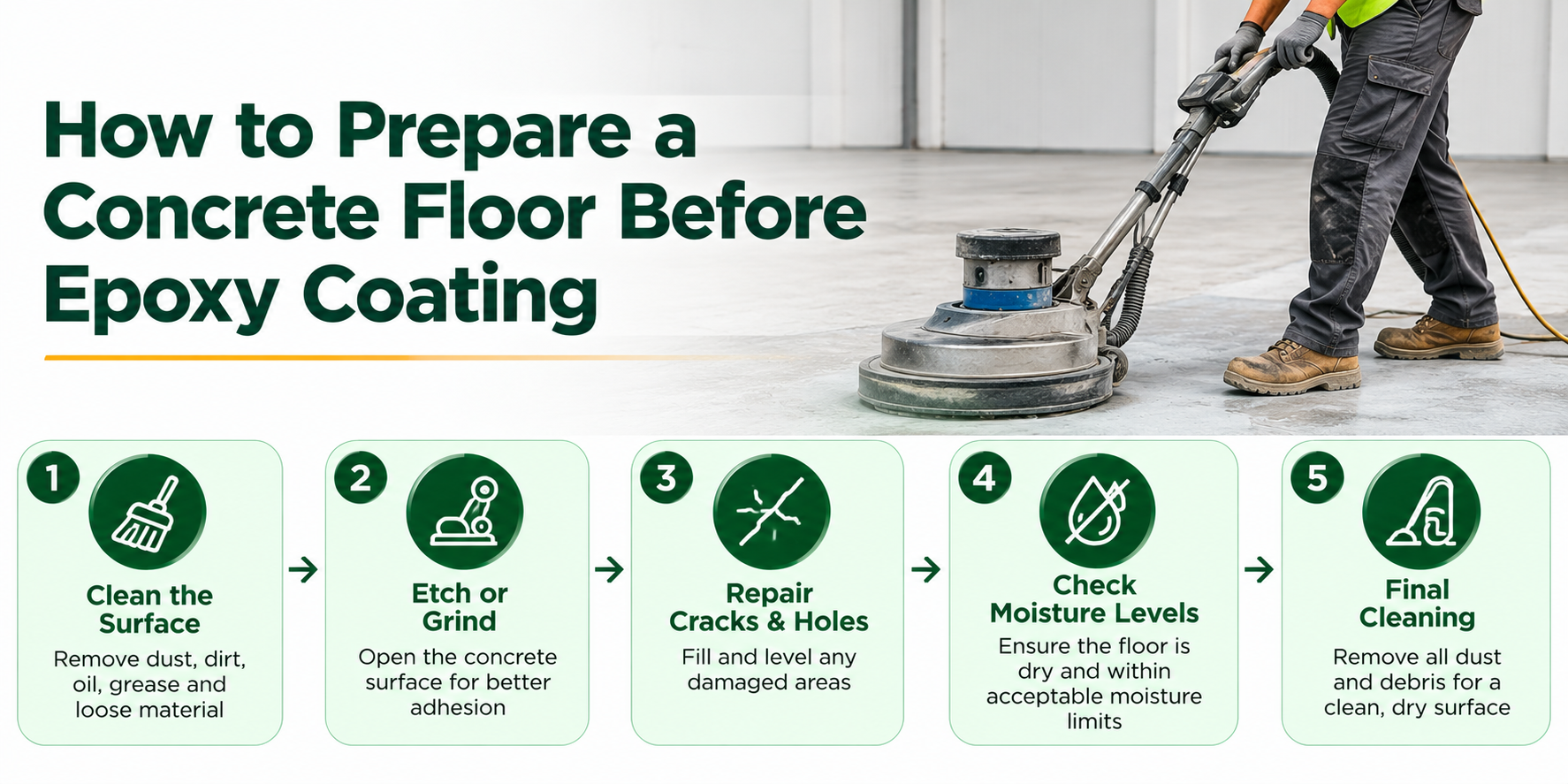
Step 2: Remove dirt, dust and contaminants
The concrete surface should be thoroughly cleaned before mechanical preparation and coating application.
Common contaminants include:
- Dust
- Dirt
- Oil
- Grease
- Chemical residues
- Paint
- Loose particles
- Manufacturing contaminants
Oil and grease require particular attention because they can penetrate into concrete and interfere with epoxy adhesion.
Suitable cleaning methods should be selected according to the type and severity of contamination.
Step 3: Remove weak concrete and existing coatings
Any loose, weak or deteriorated concrete should be removed before applying the epoxy system.
If an existing coating or paint is present, its condition should be assessed.
Depending on the substrate and existing coating, removal may involve:
- Mechanical grinding
- Shot blasting
- Scraping
- Specialized removal methods
The objective is to expose a suitable and sound substrate for the new flooring system.
Step 4: Mechanically prepare the surface
Mechanical preparation is one of the most important stages of epoxy flooring installation.
Common methods include:
Diamond grinding
Diamond grinding can remove surface contaminants, weak concrete and existing coatings while creating a suitable surface profile for epoxy application.
It is commonly used for many industrial and commercial flooring projects.
Shot blasting
Shot blasting uses abrasive media to prepare the concrete surface.
It can be useful for larger areas where controlled mechanical preparation is required.
The appropriate preparation method depends on the condition of the floor and the requirements of the selected epoxy system.
Step 5: Create the correct surface profile
Epoxy requires an appropriately prepared surface to achieve good mechanical adhesion.
Mechanical preparation creates a surface profile that allows the coating system to bond effectively with the concrete.
The required surface profile depends on:
- Epoxy system
- Coating thickness
- Concrete condition
- Application method
- Manufacturer's requirements
The goal is not simply to make the concrete look rough. The surface needs to be prepared to the level required by the specified flooring system.
Step 6: Repair cracks and damaged concrete
Cracks, holes and damaged areas should be assessed before epoxy application.
Depending on the type and cause of the damage, repairs may include:
- Crack filling
- Joint treatment
- Repair mortars
- Resin-based repair materials
- Patching damaged areas
Not every crack should be treated in the same way.
Moving or structural cracks may require additional investigation and a suitable treatment strategy before the flooring system is installed.
Step 7: Check moisture conditions
Moisture is an important consideration before applying epoxy to concrete.
Excess moisture or moisture movement through the slab can affect certain coating systems and may contribute to:
- Blistering
- Bubbling
- Delamination
- Poor adhesion
The concrete should therefore be assessed according to the requirements of the selected flooring system.
Where moisture is a concern, the cause should be identified and an appropriate solution considered before coating application.
Step 8: Treat joints and edges
Special attention should be given to:
- Expansion joints
- Construction joints
- Control joints
- Floor-to-wall junctions
- Drainage areas
- Pipe penetrations
- Corners
These locations can be more vulnerable to movement and water penetration.
The appropriate joint treatment should be selected according to the project requirements and the flooring system being installed.
Step 9: Vacuum and remove dust
After grinding or shot blasting, the floor should be thoroughly cleaned.
Industrial vacuum equipment can be used to remove:
- Concrete dust
- Abrasive particles
- Loose debris
- Fine contaminants
Dust left on the surface can interfere with epoxy adhesion.
The prepared surface should therefore be clean and free from loose material before the primer or coating is applied.
Step 10: Apply primer
Once the concrete has been properly prepared, the specified primer can be applied.
A primer can help:
- Improve adhesion
- Seal suitable concrete surfaces
- Improve coating performance
- Provide a suitable base for subsequent layers
The correct primer depends on the substrate and the complete epoxy flooring system.
Application should follow the manufacturer's technical requirements regarding mixing, coverage, temperature, pot life and curing.
Step 11: Apply the epoxy flooring system
After the primer has been applied and is ready for the next stage, the selected epoxy system can be installed.
Depending on the project, the system may include:
Primer → Base coat → Additional epoxy layer → Aggregate, where required → Topcoat
The exact number of layers and thickness depends on the required performance.
Factors such as traffic, chemical exposure, abrasion, impact and slip resistance should be considered when specifying the system.
Typical concrete preparation process
A professional epoxy flooring project may follow this sequence:
Site inspection → Concrete assessment → Cleaning → Removal of contaminants → Mechanical grinding/shot blasting → Crack and joint treatment → Dust removal → Moisture assessment → Primer → Epoxy flooring system → Curing → Final inspection
The exact process can vary according to the condition of the substrate and the selected flooring system.
What happens if the concrete is not prepared properly?
Skipping or reducing preparation work can create problems even when a high-quality epoxy product is used.
Common consequences include:
- Peeling
- Delamination
- Blistering
- Poor adhesion
- Pinholes
- Uneven appearance
- Premature wear
- Localized coating failure
For example, applying epoxy over oil-contaminated concrete can prevent proper bonding. Similarly, coating weak or dusty concrete can cause the coating to detach along with the weak surface layer.
This is why the quality of the substrate and preparation can be just as important as the coating material itself.
How long does concrete preparation take?
The preparation time depends on several factors, including:
- Total floor area
- Condition of the concrete
- Amount of contamination
- Existing coating
- Number of cracks and damaged areas
- Required preparation method
- Moisture conditions
- Flooring system being installed
A clean and sound concrete floor may require less preparation than an old industrial floor with heavy oil contamination, damaged concrete and existing coatings.
A proper site assessment is therefore necessary before estimating the project duration.
Concrete floor preparation checklist
Before epoxy application, the following should be checked:
| Preparation requirement | What to check |
|---|---|
| Surface condition | Concrete should be sound and suitable for coating |
| Cleaning | Dust, oil, grease and contaminants removed |
| Existing coating | Loose or unsuitable coatings removed |
| Mechanical preparation | Required surface profile achieved |
| Cracks | Properly assessed and treated |
| Joints | Appropriate treatment completed |
| Moisture | Conditions assessed according to system requirements |
| Dust removal | Surface thoroughly vacuum cleaned |
| Primer | Correct primer selected and applied |
| Environment | Temperature and humidity suitable for application |
Can epoxy be applied directly over old concrete?
In some cases, yes, but the concrete must first be properly assessed and prepared.
Old concrete may contain:
- Oil
- Grease
- Paint
- Previous coatings
- Weak surface layers
- Cracks
- Moisture
- Surface contamination
The age of the concrete alone does not determine whether it is suitable for epoxy.
The important factors are the condition, strength, cleanliness, moisture condition and suitability of the substrate for the selected flooring system.
How to prepare an industrial floor for long-term performance
Good preparation should be combined with the correct flooring specification.
The complete approach should consider:
Concrete condition + Surface preparation + Flooring system + Application quality + Maintenance
For example, a warehouse with forklift traffic may require a different epoxy system from a showroom, while an automobile workshop may have different requirements because of oil and chemical exposure.
The flooring system should therefore be selected according to the actual operating environment.
The AHT approach
At AHT – AI-HI Tech Coating, we understand that successful epoxy flooring starts with the concrete underneath.
Our approach focuses on proper surface inspection, mechanical preparation, cleaning, crack and joint treatment, primer application and installation of the appropriate flooring system according to the requirements of each project.
Whether you are preparing a factory, warehouse, automobile workshop, manufacturing facility, showroom, commercial building or industrial plant, proper concrete preparation can help create a strong foundation for a durable flooring system.
Need professional concrete floor preparation and epoxy flooring?
Contact AHT – AI-HI Tech Coating for professional epoxy flooring, industrial flooring, PU flooring, concrete floor preparation and protective coating solutions tailored to your project requirements.
Prepare the surface properly. Build a stronger floor. Deliver long-term performance.