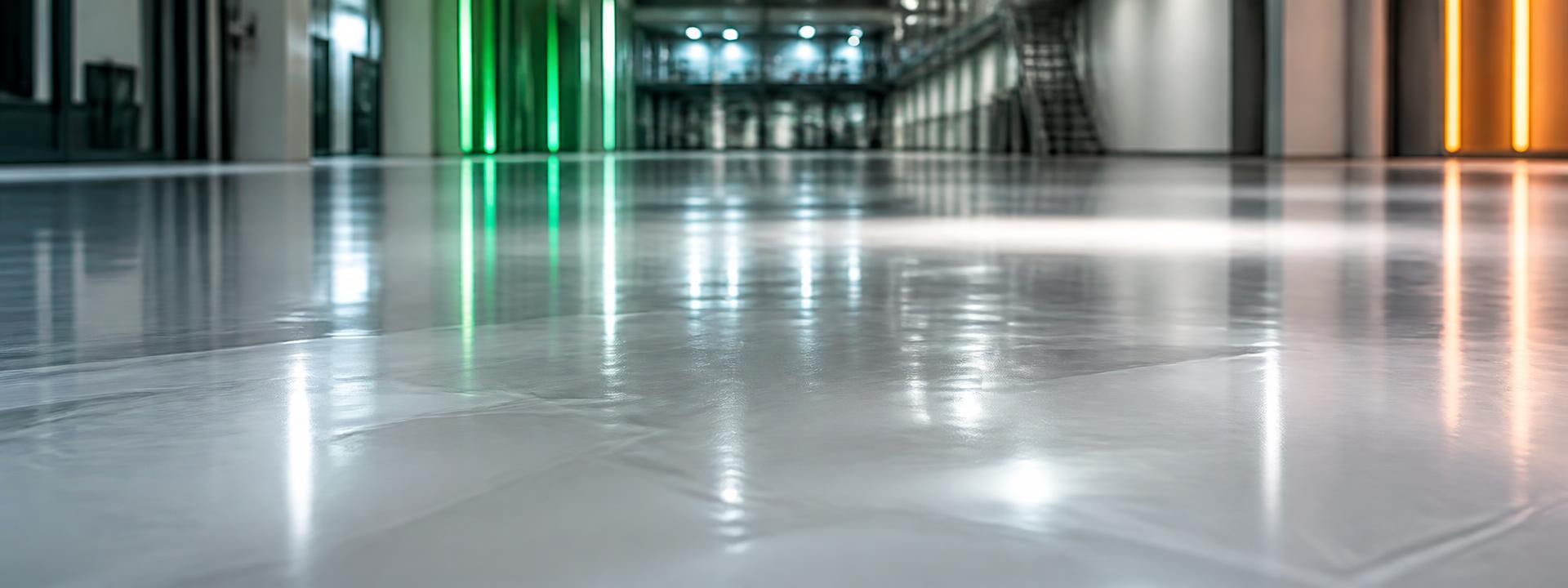
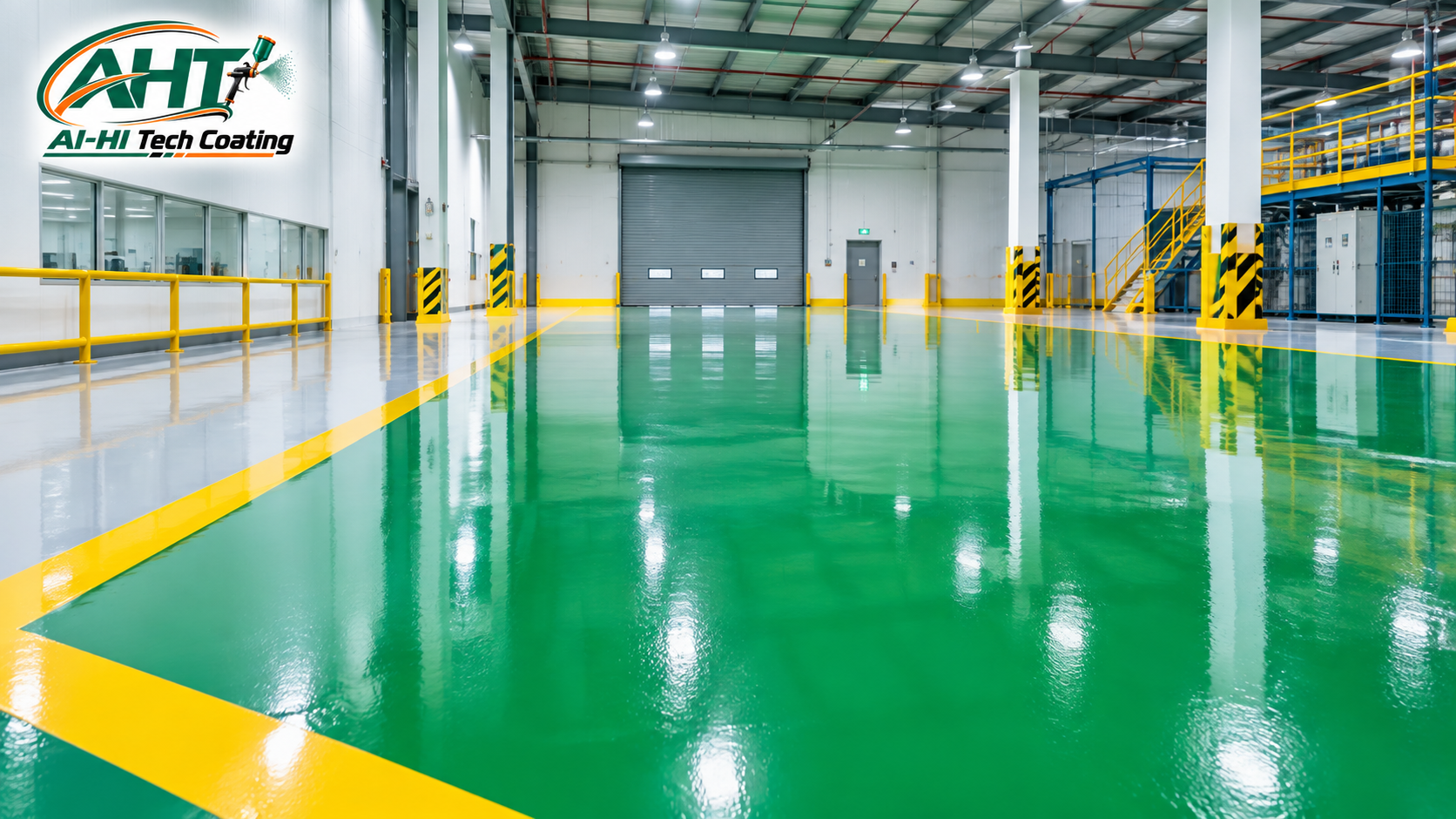
Epoxy flooring is a durable, seamless floor coating system made by combining epoxy resin with a hardener. When properly mixed and applied to a prepared concrete surface, the materials chemically react and cure to form a strong, hard-wearing surface.
Epoxy flooring is widely used in industrial, commercial and high-traffic environments because of its durability, easy maintenance, attractive finish and resistance to abrasion and many chemicals.
Understanding epoxy flooring
Epoxy flooring is not simply a layer of paint applied to concrete. It is a complete flooring system that can include surface preparation, primer, epoxy coating, additional build coats, decorative finishes and protective topcoats.
The system can be designed according to the requirements of the area, including traffic levels, mechanical loads, chemical exposure, hygiene requirements, slip resistance and appearance.
A properly specified and professionally installed epoxy flooring system can provide a long-lasting and reliable surface for factories, warehouses, workshops, showrooms, commercial buildings and many other applications.
How does epoxy flooring work?
Epoxy flooring is generally made by combining two main components:
Component Purpose
Epoxy resin Provides the coating’s main structure, adhesion and protective properties
Hardener Reacts with the resin to create the cured, hard surface
Once the resin and hardener are mixed in the manufacturer’s specified ratio, the material is applied to the prepared surface. It then cures to form a strong and seamless flooring system.
The performance of the finished floor depends not only on the epoxy material but also on surface preparation, application technique, thickness, curing conditions and the suitability of the system for the environment.
What are the benefits of epoxy flooring?
Epoxy flooring offers several advantages for industrial and commercial applications.
1. High durability
Epoxy flooring can withstand regular foot traffic, vehicle movement and mechanical wear when the correct system is selected and properly installed.
This makes it suitable for environments such as factories, warehouses, workshops and manufacturing facilities.
2. Chemical resistance
Many epoxy systems provide resistance to a range of oils, fuels, cleaning chemicals and other substances.
However, chemical resistance varies between products and formulations. The expected chemicals, concentration, temperature and exposure time should be considered when selecting a flooring system.
3. Easy to clean and maintain
The seamless nature of many epoxy flooring systems creates a smooth surface with fewer areas where dirt and contaminants can accumulate.
Regular cleaning and appropriate maintenance can help maintain the appearance and performance of the floor.
4. Seamless finish
Unlike traditional flooring materials that may contain numerous joints or seams, epoxy flooring can create a continuous surface when correctly installed.
This can provide a clean and professional appearance while making routine cleaning easier.
5. Abrasion resistance
Industrial floors can experience constant movement from people, vehicles, machinery and equipment.
A properly selected epoxy system can provide good resistance to everyday abrasion and wear, helping protect the underlying concrete.
6. Customizable appearance
Epoxy flooring is available in a wide range of colours and finishes.
Depending on the system, it can be designed with:
* Plain colours
* High-gloss finishes
* Matte finishes
* Decorative flakes
* Anti-skid textures
* Metallic decorative effects
* Different colour combinations
This allows epoxy flooring to be used for both functional and decorative applications.
7. Improved floor protection
Epoxy can act as a protective layer over concrete, helping reduce direct exposure to abrasion, spills and everyday industrial use.
The correct system can help extend the service life of the underlying floor when the concrete is properly prepared and the coating is correctly installed.
8. Anti-skid options
For areas where slip resistance is important, suitable aggregates or textured finishes can be incorporated into the flooring system.
Anti-skid epoxy flooring can be particularly useful in:
* Ramps
* Automobile workshops
* Industrial facilities
* Loading areas
* Wet working environments
* Parking areas
The required level of slip resistance should be selected according to the actual site conditions and application requirements.
Types of epoxy flooring
Different epoxy systems are available for different applications and performance requirements.
1. Epoxy coating
Epoxy coating systems are commonly used where a durable protective layer is required over a prepared concrete surface.
They can be suitable for workshops, commercial areas, warehouses and other environments with light to moderate traffic, depending on the system specification.
2. High-build epoxy flooring
High-build epoxy systems provide a thicker and more robust coating than conventional thin-film systems.
They can be used in areas exposed to increased traffic, abrasion and mechanical activity.
3. Self-leveling epoxy flooring
Self-leveling epoxy systems are designed to create a smooth and uniform surface when applied correctly over a properly prepared substrate.
They are commonly considered for factories, warehouses, commercial facilities, laboratories, showrooms and other areas where a smooth finish is required.
4. Epoxy flake flooring
Decorative flakes can be broadcast into an epoxy system to create a textured and visually attractive finish.
This type of flooring can be suitable for garages, showrooms, commercial spaces and selected residential applications.
5. Heavy-duty epoxy flooring
Heavy-duty systems are designed for demanding industrial environments where floors are exposed to significant mechanical traffic, loads and abrasion.
The exact system should be selected according to the expected operating conditions.
6. Anti-skid epoxy flooring
Anti-skid systems incorporate suitable aggregates or textured finishes to improve traction.
They can be used in workshops, ramps, industrial areas and other locations where additional slip resistance is required.
Where is epoxy flooring used?
Epoxy flooring can be used across a wide range of industries and environments.
Common applications include:
* Factories
* Warehouses
* Automobile workshops
* Service centres
* Manufacturing plants
* Pharmaceutical facilities
* Hospitals and healthcare areas
* Commercial buildings
* Showrooms
* Garages
* Parking areas
* Laboratories
* Industrial plants
The flooring system should always be selected according to the specific conditions of the site.
How is epoxy flooring installed?
Professional epoxy flooring installation generally follows a systematic process:
Site inspection → Surface preparation → Cleaning → Crack and joint treatment → Primer → Epoxy application → Additional coats/topcoat → Curing
Surface preparation
Surface preparation is one of the most important stages of an epoxy flooring project.
Concrete may require mechanical grinding or another suitable preparation method to remove weak material, contamination and existing coatings and to create an appropriate surface profile.
Primer application
Depending on the flooring system, a compatible primer may be applied to improve adhesion and prepare the substrate for subsequent layers.
Epoxy application
The selected epoxy system is mixed according to the manufacturer’s technical requirements and applied at the specified thickness using appropriate tools and techniques.
Finishing and curing
Additional coats, decorative finishes, anti-skid aggregates or topcoats may be applied depending on the system.
The floor must then be allowed to cure under suitable environmental conditions before it is returned to service.
Is epoxy flooring suitable for every floor?
No.
Epoxy flooring is highly versatile, but the correct system depends on the condition and intended use of the floor.
Before installation, factors such as:
* Concrete condition
* Moisture
* Existing coatings
* Traffic
* Mechanical loads
* Chemical exposure
* Temperature
* Slip resistance
* Required thickness
* Maintenance requirements
should be evaluated.
Poor surface preparation or selecting the wrong flooring system can result in problems such as peeling, blistering, cracking or premature wear.
Why professional installation matters
The quality of an epoxy floor depends on much more than the product itself.
Correct surface preparation, mixing ratios, application thickness, environmental conditions, recoat intervals and curing requirements all play an important role in the final performance of the flooring system.
Professional installation helps ensure that the selected system is properly prepared, applied and finished according to the project requirements and manufacturer’s technical specifications.
How to choose the right epoxy flooring system
The best epoxy flooring system is the one that matches the actual conditions of the facility.
Before selecting a system, consider:
Traffic → Load → Chemical exposure → Surface condition → Required thickness → Slip resistance → Cleaning → Appearance → Operating environment
A factory with forklifts and heavy machinery will require a different solution from a showroom with mainly pedestrian traffic.
Epoxy flooring vs ordinary floor paint
Epoxy flooring should not be considered the same as ordinary floor paint.
Epoxy systems are engineered as protective flooring systems and can provide greater durability, adhesion and resistance when properly specified and installed.
The performance, however, depends on the specific product and system design. Choosing the correct material for the intended application is essential.
The AHT approach
At AHT – AI-HI Tech Coating, we focus on providing flooring and coating solutions according to the requirements of each project.
From surface preparation and material selection to application and finishing, every stage plays an important role in achieving a durable, functional and professional floor.
Whether you require flooring for a factory, warehouse, automobile workshop, commercial facility, showroom or industrial plant, the right epoxy flooring system can help improve durability, cleanliness, appearance and long-term floor performance.
Need professional epoxy flooring for your facility?
Contact AHT – AI-HI Tech Coating for professional epoxy flooring, industrial flooring and protective coating solutions tailored to your project requirements.
Right system. Proper preparation. Professional application. Long-lasting performance.