Concrete is one of the most widely used flooring materials in factories, warehouses, workshops and industrial facilities. It is strong, economical and capable of handling significant loads. However, industrial concrete floors are exposed to demanding conditions every day.
Heavy machinery, forklifts, chemicals, oil, moisture, impact, abrasion and continuous traffic can gradually damage an unprotected or poorly constructed concrete floor.
Understanding why concrete floors fail is important for choosing the right repair, protective coating or industrial flooring system before minor problems become major maintenance issues.
What causes concrete floor failure?
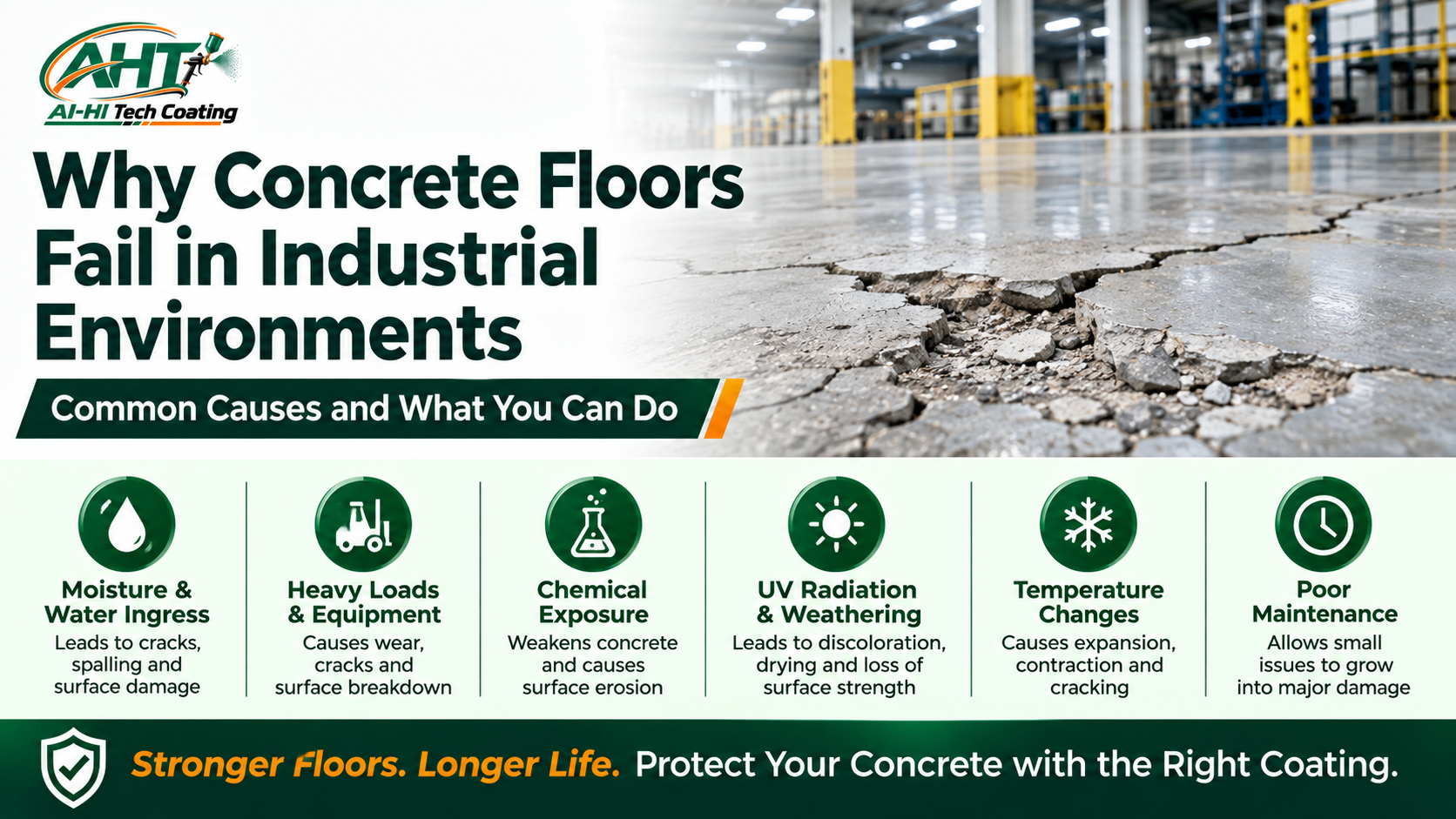
Concrete floor failure rarely happens because of one single reason. In most industrial environments, several factors can work together over time.
Common causes include:
- Heavy traffic and repeated loading
- Forklift and vehicle movement
- Abrasion and surface wear
- Chemical exposure
- Oil and grease contamination
- Moisture
- Poor drainage
- Concrete cracking
- Weak or poorly prepared substrates
- Improper construction or curing
- Poor maintenance
- Incorrect repair methods
Identifying the actual cause of deterioration is important before selecting a repair or coating system.
1. Heavy traffic and mechanical wear
Industrial floors are often subjected to continuous movement of:
- Forklifts
- Pallet trucks
- Vehicles
- Heavy machinery
- Material handling equipment
- Workers and production equipment
Repeated traffic can gradually wear the concrete surface.
Forklift turning, braking and acceleration can create particularly high mechanical stresses in specific areas.
Over time, this may result in:
- Surface wear
- Dusting
- Abrasion
- Ruts
- Cracking
- Localized damage
High-traffic areas may require a flooring or protective system designed specifically for their operating conditions.
2. Concrete dusting
Concrete dusting occurs when weak or poorly bonded particles at the surface become loose and are released through normal traffic and abrasion.
Industrial dust can create several problems:
- Dirty working areas
- Increased cleaning requirements
- Dust contamination
- Reduced surface quality
- Potential impact on equipment and products
Dusting can be associated with factors such as poor finishing, inadequate curing, weak surface concrete or unsuitable construction practices.
A suitable surface treatment or coating can help control dusting when the underlying concrete is suitable for treatment.
3. Cracks in industrial concrete floors
Cracking is one of the most visible signs of concrete floor deterioration.
Cracks can occur for different reasons, including:
- Drying shrinkage
- Thermal movement
- Settlement
- Structural movement
- Overloading
- Poor joint design
- Substrate movement
- Improper construction
Not every crack has the same significance.
Before applying an industrial coating, cracks should be inspected to determine their type and likely cause.
Simply covering a crack without addressing the underlying issue may result in the crack appearing again through the new flooring system.
4. Chemical exposure
Industrial facilities may use chemicals as part of manufacturing, cleaning or maintenance processes.
Concrete can be affected by exposure to substances such as:
- Acids
- Alkalis
- Solvents
- Oils
- Fuels
- Cleaning chemicals
- Industrial liquids
The effect depends on the type of chemical, concentration, temperature and duration of exposure.
Chemical attack can contribute to surface deterioration and loss of concrete performance.
Where chemical exposure is expected, the floor should be protected using a system selected specifically for the chemicals involved.
5. Oil and grease contamination
Factories, automobile workshops and engineering facilities can experience frequent exposure to:
- Engine oil
- Hydraulic oil
- Lubricants
- Grease
- Fuels
- Industrial fluids
Oil and grease can penetrate porous concrete and make cleaning more difficult.
They can also interfere with the adhesion of coatings if the contaminated surface is not properly cleaned and prepared.
Before applying epoxy or another flooring system, oil-contaminated concrete may require specialized cleaning and mechanical preparation.
6. Moisture and water-related problems
Moisture is another important factor in concrete floor deterioration.
Industrial floors can be exposed to moisture through:
- Ground moisture
- Water leakage
- Cleaning operations
- Poor drainage
- Standing water
- Plumbing leaks
- Rainwater entering the facility
Excess moisture can also create problems for certain coating systems if the substrate is not properly assessed before application.
Possible signs of moisture-related problems include:
- Damp areas
- Blistering
- Coating delamination
- Discoloration
- Efflorescence
- Persistent wet patches
Moisture conditions should therefore be evaluated before installing an industrial coating.
7. Poor drainage and standing water
Water should be able to drain effectively from an industrial floor.
Poor drainage can result in standing water around:
- Floor drains
- Production areas
- Washing zones
- Loading areas
- Doorways
- Ramps
Continuous water exposure can contribute to surface deterioration and create operational and safety concerns.
An effective flooring solution should therefore be considered together with the facility's drainage requirements.
8. Impact and heavy loads
Industrial floors can experience significant impact from:
- Dropped equipment
- Heavy components
- Machinery
- Pallets
- Metal objects
- Material handling operations
Repeated impact can damage the concrete surface and create localized cracks, chips or broken areas.
Areas with frequent impact may require a more robust flooring system than areas exposed only to pedestrian traffic.
9. Poor surface preparation before coating
Sometimes the concrete itself is not the only problem.
A coating can fail because the concrete surface was not properly prepared before application.
Common preparation problems include:
- Dust and loose material
- Oil and grease
- Existing weak coatings
- Contamination
- Poor surface profile
- Weak concrete
- Inadequate cleaning
If a coating is applied over an unsuitable surface, it may result in:
- Peeling
- Delamination
- Blistering
- Poor adhesion
- Premature wear
Proper surface preparation is therefore one of the most important stages of an industrial flooring project.
10. Improper curing and construction practices
The long-term performance of a concrete floor can be affected by how the concrete was originally installed.
Factors such as:
- Incorrect water-cement ratio
- Poor curing
- Inadequate compaction
- Improper finishing
- Incorrect joint placement
- Insufficient concrete strength
- Poor construction practices
can contribute to premature deterioration.
For an existing floor, the condition of the concrete should be assessed before deciding whether repair, resurfacing, coating or another solution is appropriate.
Common signs that an industrial concrete floor is failing
Regular inspection can help identify deterioration at an early stage.
Look for:
- Cracks
- Surface dusting
- Potholes
- Broken concrete
- Peeling coatings
- Oil stains
- Surface erosion
- Uneven areas
- Exposed aggregate
- Standing water
- Worn forklift lanes
- Damaged joints
Early identification can help prevent localized problems from becoming more extensive.
How can industrial concrete floors be protected?
The appropriate solution depends on the condition of the concrete and the operating environment.
Possible solutions may include:
- Concrete repairs
- Crack and joint treatment
- Surface grinding
- Protective coatings
- Epoxy flooring
- PU flooring
- High-build flooring systems
- Self-leveling systems
- Anti-skid flooring
- Chemical-resistant coatings
The objective is not simply to cover the concrete, but to select a system that addresses the actual conditions affecting the floor.
Why surface preparation matters
Before applying epoxy or another protective flooring system, the concrete should be properly assessed and prepared.
A typical preparation process may include:
Inspection → Cleaning → Mechanical grinding/shot blasting → Oil and contaminant removal → Crack and joint treatment → Vacuum cleaning → Primer → Flooring system
The exact process depends on the condition of the concrete and the selected flooring system.
Proper preparation helps improve adhesion and can reduce the risk of premature coating failure.
How to choose the right protection for your concrete floor
There is no single flooring system suitable for every industrial environment.
The appropriate solution should be selected according to:
| Requirement | Consideration |
|---|---|
| Traffic | Pedestrian, forklift or vehicle traffic |
| Load | Machinery and equipment weight |
| Abrasion | Level of surface wear |
| Chemical exposure | Type and concentration of chemicals |
| Impact | Risk of dropped materials or equipment |
| Moisture | Condition of the concrete and water exposure |
| Slip resistance | Wet, oily or high-risk areas |
| Cleaning | Frequency and cleaning chemicals |
| Temperature | Operating and cleaning temperatures |
| Existing condition | Cracks, damage and contamination |
A professional site assessment can help determine whether the floor requires repair, coating, resurfacing or a complete flooring system.
When should you consider epoxy or PU flooring?
Epoxy and PU flooring can be considered when an industrial concrete floor requires additional protection and the substrate is suitable for the selected system.
Epoxy flooring may be suitable when:
- High hardness is required
- Abrasion resistance is important
- Chemical resistance is required
- A seamless surface is desired
- The area has industrial traffic
- Easy cleaning is important
PU flooring may be considered when:
- Greater flexibility is required
- Temperature variations are significant
- High impact and abrasion resistance are important
- The environment has demanding cleaning conditions
- A specialized industrial flooring system is required
The final selection should always be based on the actual conditions of the site.
How to prevent concrete floor failure
Preventive maintenance can help extend the useful life of industrial floors.
Recommended practices
- Inspect the floor regularly
- Repair cracks and damaged areas early
- Clean oil and chemical spills promptly
- Maintain proper drainage
- Avoid unnecessary impact
- Monitor high-traffic areas
- Use suitable protective coatings where required
- Follow the recommended maintenance procedure
- Select flooring systems according to actual operating conditions
Preventing deterioration is often more practical than waiting until extensive repairs are required.
Concrete floor repair vs protective coating
Not every damaged concrete floor should simply be coated.
If the substrate has significant structural damage, major cracking, severe deterioration or other underlying problems, those issues should be assessed and addressed first.
A protective coating or industrial flooring system is most effective when applied over a suitable and properly prepared substrate.
The correct approach may therefore be:
Inspect → Identify the cause → Repair the substrate → Prepare the surface → Select the right system → Apply → Maintain
The AHT approach
At AHT – AI-HI Tech Coating, we focus on understanding the condition and requirements of each industrial floor before recommending a suitable flooring or protective coating system.
From surface inspection and concrete preparation to crack treatment, primer application, epoxy or PU flooring and final finishing, every stage plays an important role in achieving reliable performance.
Whether you are dealing with cracks, dusting, oil contamination, heavy traffic, chemical exposure, abrasion or general concrete deterioration, the appropriate solution can help improve the durability, cleanliness and performance of the floor.
Is your industrial concrete floor showing signs of deterioration?
Contact AHT – AI-HI Tech Coating for professional epoxy flooring, PU flooring, industrial flooring, protective coatings and concrete floor solutions tailored to your project requirements.
Identify the problem. Protect the surface. Extend floor performance.